The Room That Never Became Anything, And Why I Still Won't Clear It
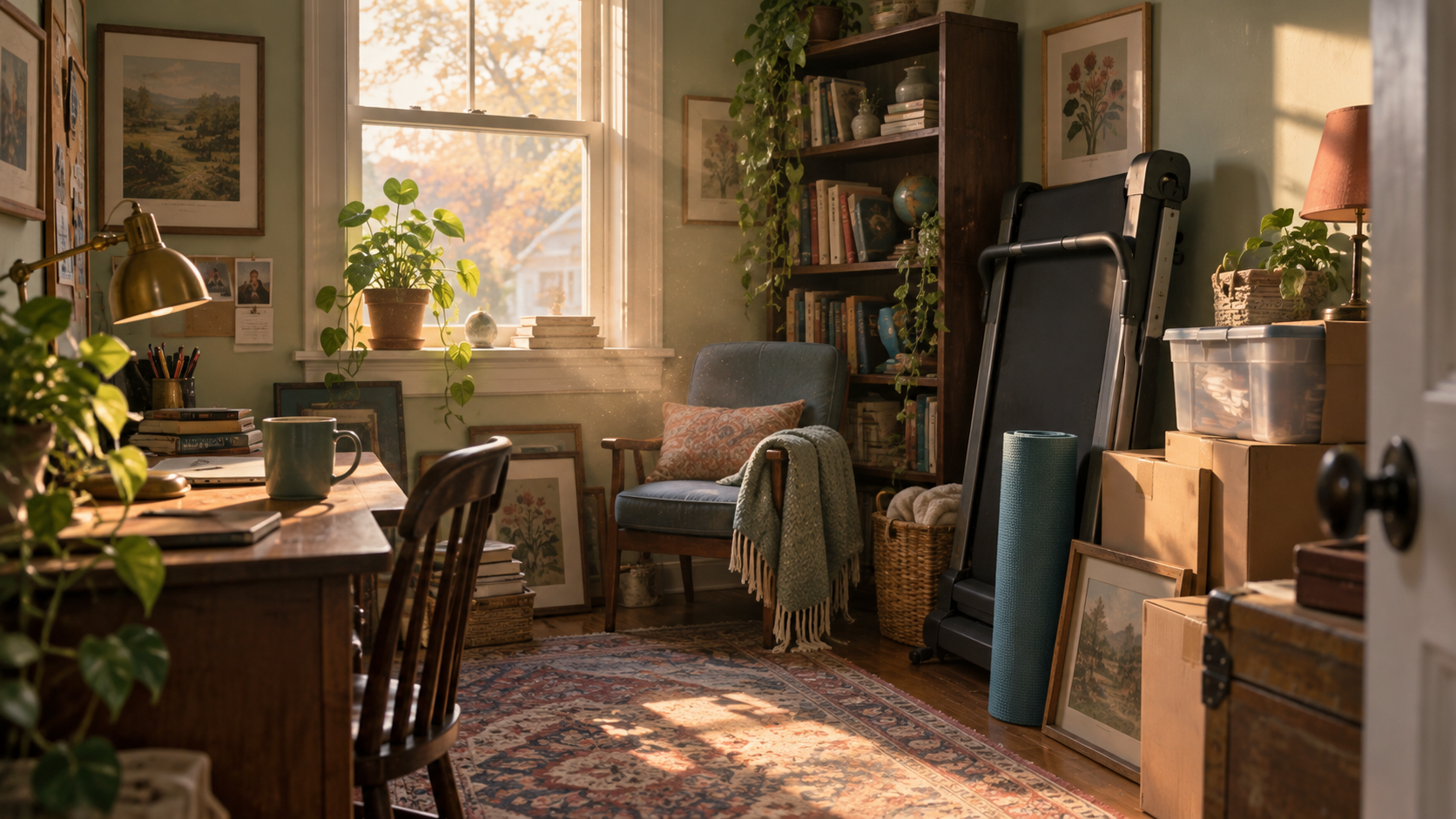
Every house I know of, given enough time, grows a room that stops being anything in particular. Ours has one. It was, for a while, an office of sorts, then a place where a treadmill went to be resented, and now it functions almost entirely as a room where boxes go to be forgotten, which is a job it performs with real distinction and no supervision whatsoever.
I went in there recently looking for a specific document and came out forty minutes later having found, instead, a folding chair from a boat I sold the better part of a decade ago, a set of maps for a country I haven't worked in since before some of its roads existed, and a box of cables belonging to devices I'm fairly confident no longer exist in any working form anywhere on earth. Not one of these objects has been touched in years. Not one of them has been thrown out either, and I want to be honest about why, because the honest answer isn't sentiment, whatever I'd like to claim for it. The honest answer is that throwing them out requires deciding, definitively, that a particular chapter is finished, and it turns out I would rather live beside the evidence of forty years than stand in a room and formally close the file on any of it.
This is, I've come to suspect, the actual mechanism behind an enormous amount of housing commentary that treats the whole business as pure arithmetic — too many square feet, too few people, sell up, move on, free the market. The arithmetic isn't wrong. It's just not the whole shape of the problem, because a spare room full of unopened boxes isn't inefficiency in the way an economist means it. It's a very slow, very quiet form of grief management, conducted entirely without ceremony, using cardboard.
I had my tea-spitting moment on this one reading a piece that described downsizing as simply "releasing equity," as though a house were a savings bond you'd forgotten to cash in rather than the physical container for every decision you've ever actually stood by. Releasing equity. As if the difficult part were financial rather than the fact that selling the house means admitting, out loud and in front of an estate agent, that the life it was built to hold has changed shape completely and isn't going back.
I don't have a plan for the room, and I want to be honest about that too, rather than pretending I'm three months from finally sorting it. I go in every so often, move a box from one side to the other, decide the cables might genuinely be useful one day for a device that doesn't exist, and leave again feeling, on balance, that I've made progress, despite an enormous quantity of available evidence to the contrary.
Somewhere in a filing cabinet in that same room there's almost certainly a folder marked "sort this properly," in my own handwriting, from a house move that happened long enough ago that I no longer entirely trust the date on it. I haven't opened it. I'm not sure I'm going to. Some rooms, I've decided, aren't for sorting. They're for keeping the argument going a little longer, one unopened box at a time.
The fuller version of this — what the actual housing numbers say, and why I still haven't sold the house despite agreeing with roughly half the case against me — is up now at The Old Grey Thinker on Substack: https://theoldgreythinker.substack.com/p/start-here
Want something more practical?
I’ve created a collection of guides for people who still believe life isn’t over just because the calendar says so. You’ll find them here:
https://greythinker.gumroad.com/
Tea remains the official fuel source of The Old Grey Thinker.
And if you’d simply like to support the writing, some readers buy me a
http://buymeacoffee.com/theoldgreythinker
It’s not mandatory. But neither is keeping the lights on.


Comments
Post a Comment