The Invisible People Holding the Whole Thing Together
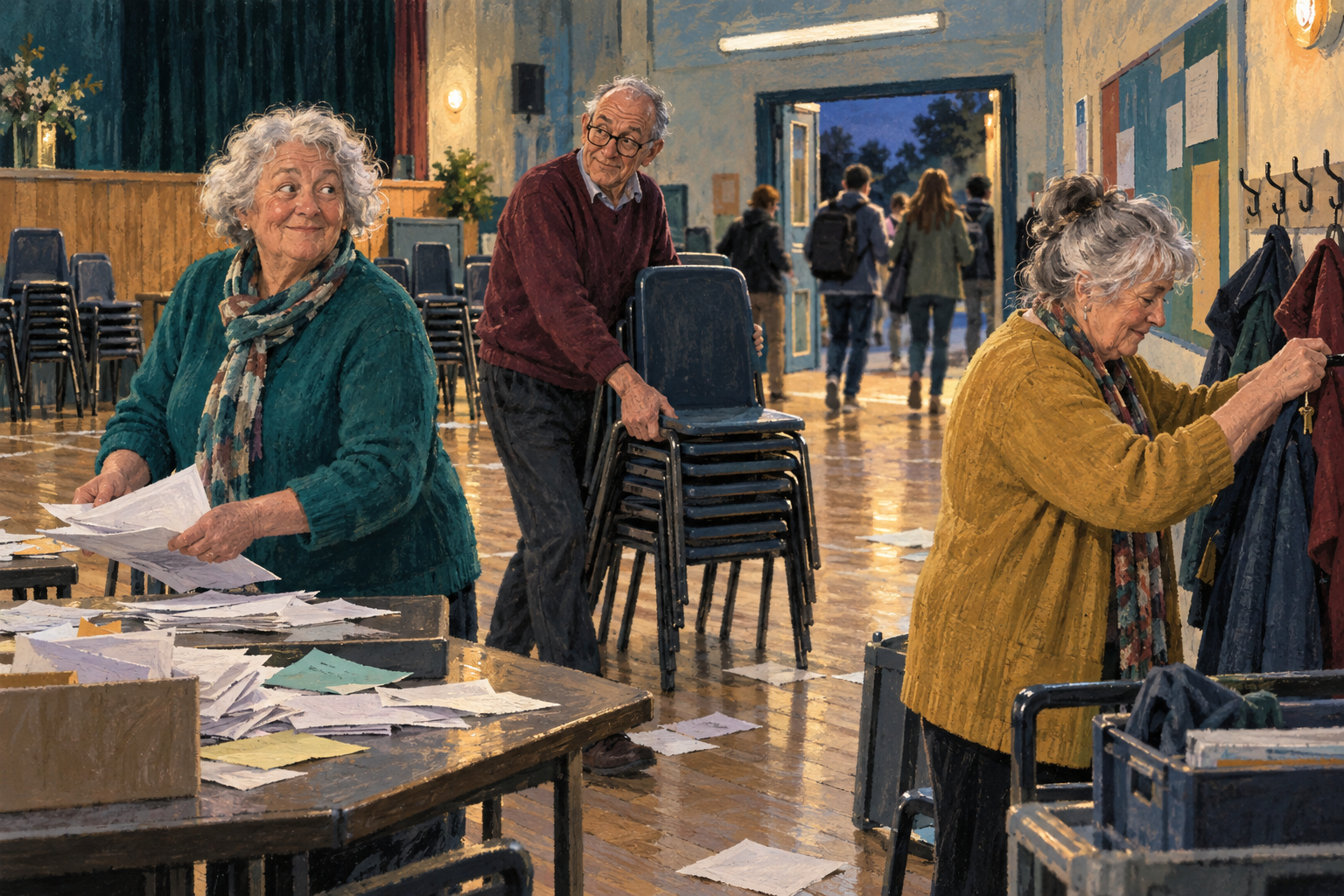
The room was tidy because older people had stayed behind.
That is not a metaphor.
It was an actual room, with actual chairs, actual paper cups, actual notices curling at the corners, and the usual pile of abandoned belongings that appears after every public event as if adults are secretly moulting.
The important people had gone. You can tell who the important people are because they leave first, often while talking about how valuable everyone is. They carry folders, phones, and the expression of people already late for something more strategic.
The room remained. And in the room were the invisible ones.
An older woman collecting forms into a neat pile. Another checking that the windows were shut. A man lifting chairs with the careful irritation of someone who has been doing practical things since before half the committee discovered lanyards.
Nobody applauded. Nobody called it leadership. Nobody took a photograph and wrote, "So proud of this amazing community." The room simply became usable again because people who knew how to leave things properly had not yet left.
This is one of the great uncounted facts of later life. A lot of the world is being held together by people who have become socially transparent.
They are on committees, at churches, in libraries, in neighbourhood groups, in clubs, in waiting rooms, on pavements, behind trestle tables, beside raffle books, near kettles, beside the box of extension leads. They remember who has the key. They know which door sticks. They understand that if you do not label the envelope now, nobody will find it when the treasurer is in hospital.
They are not glamorous. Glamour is usually what happens before someone else has to stack the chairs.
Older women know this invisibility earlier and more sharply than most men. I have had enough reader comments on the subject to stop pretending otherwise. There is a particular fury in being competent, educated, alert, funny, and still treated as background furniture because the world has decided you passed your display-by date sometime between useful and inconvenient.
I cannot write that from inside their skin. I can only say that once you notice it, it is everywhere.
The person everyone interrupts. The person whose idea becomes interesting only when repeated by someone younger. The person expected to remember birthdays, arrange lifts, check details, smooth tempers, notice illness, bring spare pens, find the missing receipt, and then vanish politely before credit is distributed.
Ageing often does not make people less visible because they have less to offer. It makes them less visible because they offer things that modern life has forgotten how to value.
Continuity. Judgement. Patience. Memory. The willingness to do the boring bit properly.
These qualities do not announce themselves. They do not dance. They do not come with a launch strategy. They simply prevent collapse in ways that are only noticed when absent.
There is comedy in it, naturally. There is always comedy when civilisation depends on someone called Margaret knowing where the spare batteries are while three men in expensive jackets discuss innovation. The older I get, the more I suspect the country would last roughly forty-eight hours without the quiet people who own labelled plastic boxes.
But beneath the comedy is an insult.
We have confused visibility with importance. We have mistaken noise for contribution. We have built a culture in which people who describe work are often rewarded more than people who do it. The phrase "raising awareness" has escaped into the wild and is now blocking traffic.
Meanwhile, someone older is staying behind with a bin bag.
Retirement can sharpen this feeling. Once you no longer have a title, your remaining authority has to come from presence, character, and usefulness. This is both liberating and brutal. Liberating because you are finally free of badges. Brutal because many people cannot recognise competence unless it arrives wearing one.
The good news, if we can call it that, is that invisibility has certain advantages.
You see more. You hear more. People underestimate you and reveal themselves with astonishing generosity. You learn who notices the cleaner, who thanks the person at the desk, who stands aside, who cannot bear a moment that is not about them. Age gives you a quieter radar.
And there is pleasure in doing things well without waiting for permission.
That is one of the kinder surprises of later life. You may stop being central in the old way, but you can still be consequential. You can still be the person who makes a room work. You can still know what needs doing before anyone has formed a working group to explore the possibility of maybe thinking about it.
I do not want to romanticise being ignored. It is not noble to be overlooked. It is tiring, and it makes people bitter in small, reasonable increments.
But I am beginning to think there is a difference between being unseen and being absent.
The invisible people are not absent. They are everywhere, holding the keys, sorting the papers, spotting the flaw, remembering the name, making the tea, noticing the person left out, and leaving the place better than they found it.
The room is tidy when they go.
That should tell us something, though of course most people have already left.
If this piece landed with you, the original is on Substack, along with a short guide called Nobody is Watching Now! for anyone thinking about what comes after nobody is asking you to matter anymore.
Read the original on Substack · Nobody is Watching Now! · Buy me a cup of tea


Comments
Post a Comment