My Television Wants a Password and I Have Lost Patience
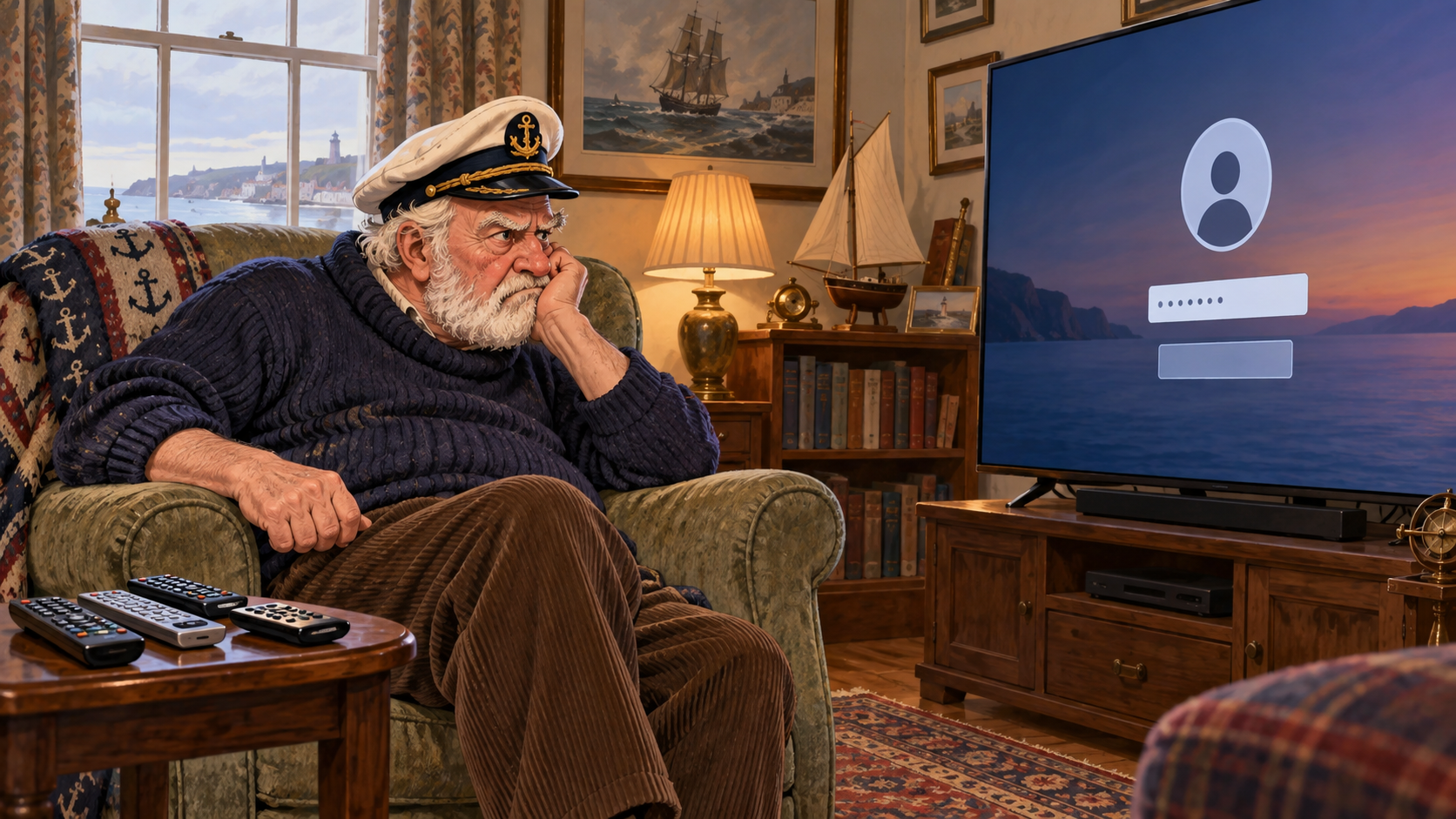
The modern world keeps mistaking inconvenience for progress, then acts surprised when older people keep a paper notebook beside the chair.
First published on The Old Grey Thinker on Substack.
I remember when a television had two jobs.
It sat in the corner and showed things.
If it failed, you hit it lightly on the side with the confidence of a generation that understood mechanical negotiation.
I am not saying this fixed anything. I am saying it gave the relationship boundaries.
Now the television wants a password.
Not content with being a television, it has become a small administrative state. It wants an account. It wants to update. It wants me to agree to terms. It wants to know whether I accept cookies, which seems an odd thing for a rectangle to ask a retired man after supper.
Worst of all, it forgets me.
This, I take personally.
I have lived in this house longer than some technology companies have existed. I have paid the bill. I have sat in the chair. I have used the same remote with the slightly suspicious battery compartment. Yet the television looks at me every few weeks as if I am a stranger trying to enter a government building through a side door.
Please sign in again.
Again.
There is a particular humiliation in being challenged by your own possessions.
The chair does not ask me to prove I own it.
The kettle does not request two-factor authentication.
The bookcase has never logged me out for security reasons.
This is why older people become loyal to objects that do one thing. It is not fear of change. Nonsense. We have survived decimalisation, strikes, computers, management consultants, mobile phones, and forms that ask for a title but do not include the one you actually use.
We can cope with change.
What we resent is being managed by badly designed progress.
There is an accusation hidden in a lot of modern life: if you struggle with the system, the fault is yours.
You are not digital enough.
You are not flexible enough.
You did not read the instructions.
You should have downloaded the app.
You should have remembered the password you created one wet afternoon in 2021 under mild emotional pressure.
Perhaps.
Or perhaps the system is rude.
Perhaps a world that requires a password to watch a programme has confused technical possibility with human decency.
Perhaps not every improvement improves the experience of the person standing in the kitchen holding a piece of paper with six codes crossed out.
The more I listen to readers, the more I think this is not really about technology. It is about dignity.
Technology is only the instrument. The tune is something older.
Who is allowed to feel competent?
Who gets treated as a problem?
Who is expected to adapt without complaint while designers remove every handle and call it intuitive?
There are days when I feel less like a customer than a suspect.
The bank wants to know if it is really me. The website wants to know if I am human. The phone wants my face. The television wants my password. The doctor's surgery wants me to begin again at eight in the morning with the reflexes of a teenage ticket tout.
Each demand is small.
That is how they get away with it.
Small demands gather. They sit in the nervous system. They make ordinary errands feel like examinations. They turn capable people into people who hesitate before pressing a button, not because they are stupid, but because one wrong press now opens a corridor of nonsense.
I know what some will say. Security matters. Fraud is real. Systems are complicated. Businesses must protect users.
Yes.
And doors still need handles.
That is all I am asking.
I am not asking to return to a fantasy past where everything worked and nobody lost the remote. The past had plenty wrong with it, including several wallpapers that should have been reported. But ordinary objects once understood their place in the hierarchy.
A watch told the time.
A phone made calls.
A television showed the programme.
Now every object wants a relationship.
It wants an account. It wants updates. It wants feedback. It wants permissions. It wants to improve your experience by making you worse at being calm.
This is why the paper diary has become radical again.
Not quaint.
Radical.
A paper diary does not vanish when the battery dies. It does not change its interface overnight. It does not ask if you enjoyed using Tuesday. It lies there, available, faintly judgmental perhaps, but honest.
The same goes for the address book, the handwritten list, the envelope marked "important numbers," the little notebook where passwords live despite every expert telling you this is a bad idea. Experts are often right. They are also often not in the room when someone simply needs to find the prescription login before the surgery line closes.
The point is not that analogue is morally superior.
The point is that visible things reduce dread.
Dread is the hidden tax of badly designed modernity.
You pay it before you even start.
You pay it when the app updates.
You pay it when the code does not arrive.
You pay it when the cheerful chatbot says, "I understand," while demonstrating no evidence of understanding anything beyond the market value of your remaining patience.
I do not hate technology. That is the lazy version of the argument.
I hate being made small by technology that claims to serve me.
There is a difference.
Good technology disappears into use. Bad technology stands in front of the thing you came for and asks whether you have tried restarting your soul.
So yes, I will keep the paper diary. I will keep the list. I will write down the number. I will label the cable. I will allow the television to update only under protest and with witnesses.
This is not stubbornness.
This is self-defence with stationery.
And if the television logs me out again, I may hit it lightly on the side.
Not to fix it.
For old time's sake.
Read the original, and the comments, on Substack: My Television Wants a Password and I Have Lost Patience
This, unbelievably, is not backed by a gleaming media empire, a glass office, or a man called Hugo in brand partnerships. It is one old grey thinker, several unreasonable opinions, and enough Yorkshire Tea to refloat a modest ferry.
So if this piece made you laugh, mutter "that's true," or stare into the middle distance like a pensioner who has just discovered the price of printer ink, do the decent thing.
Take out an annual subscription to The Old Grey Thinker. Read another piece on Medium. Buy me a tea. Or pick up The Second Act Playbook or The Creator Library.
It will not bankrupt you.
It may even improve your character.
And frankly, given the heroic public service I am performing by being this wise, this underfunded, and this magnificently cool, I think we can all agree I deserve it.


Comments
Post a Comment